Winter Is Coming

Inspiration is a funny thing.

Gardening Know How asked me to write a piece about building hoop houses. I didn’t know a single thing about building hoop houses. So I researched it, and then I wrote my authoritative article, and then I built one of my own. In that order.

This little guy is my boyfriend, Ben. I enlisted his help because he loves building projects, and he loves trips to the Home Depot. He’s never been too keen on squishing around in foamy buckets of fermented fruit, so this was a good opportunity to do something together. 20151004_142425

We’re hovering right around the first frost date for our area, depending upon who you ask. Some say it’s as early as October 3rd, and some say it’s as late as October 31st. Looking at the forecast, I’m more inclined to believe the latter. This wild map suggests that it varies by a few weeks within the city, with the line following, as far as I can tell, the contours of the hills.

So I may be a few weeks early. Or I may not be. I have too many frost sensitive plants that are just starting to produce in earnest to want to cut it close, though.

Construction was a breeze. My plot is roughly ten feet by three feet. We bought four ten-foot lengths of PEX tubing and sunk them deep into the soil. This made a tunnel just high enough to cover everybody. The trellis didn’t make the cut, but the cucumbers and melons on it had all but given up for the season, anyway. It was a mercy killing.

The cross beam was… improvised. Across the top we zip-tied three wooden stakes I’d been using as a trellis. The ends were still wet with dirt. The plan is to replace them this weekend with an irrigation pipe of some sort. But for now the stakes are performing admirably.
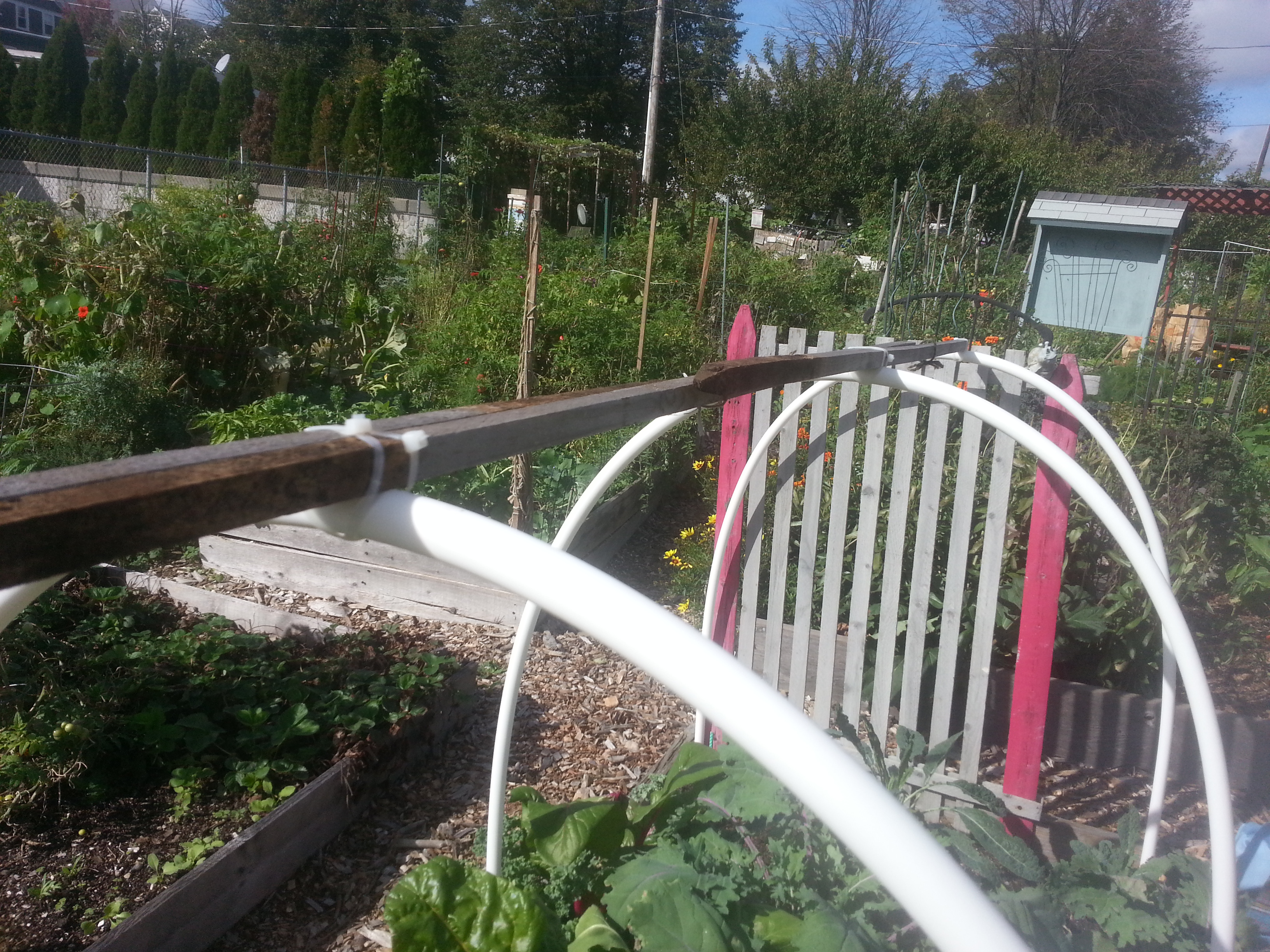
20151004_143551

We draped a single translucent plastic tarp over the whole thing. It’s ten feet wide, so it overlaps just right with the sunken ten foot poles. It’s roughly a million feet long, so even with plenty of slack to fold up securely on either end, we cut off quite a bit extra that I plan to rig up into a smaller enclosure for my container garden by the house. We attached it to the structure with a bargain bag’s worth of plastic clamps.

20151004_144456

And that’s it! From inside, it looks like a veritable tropical paradise!
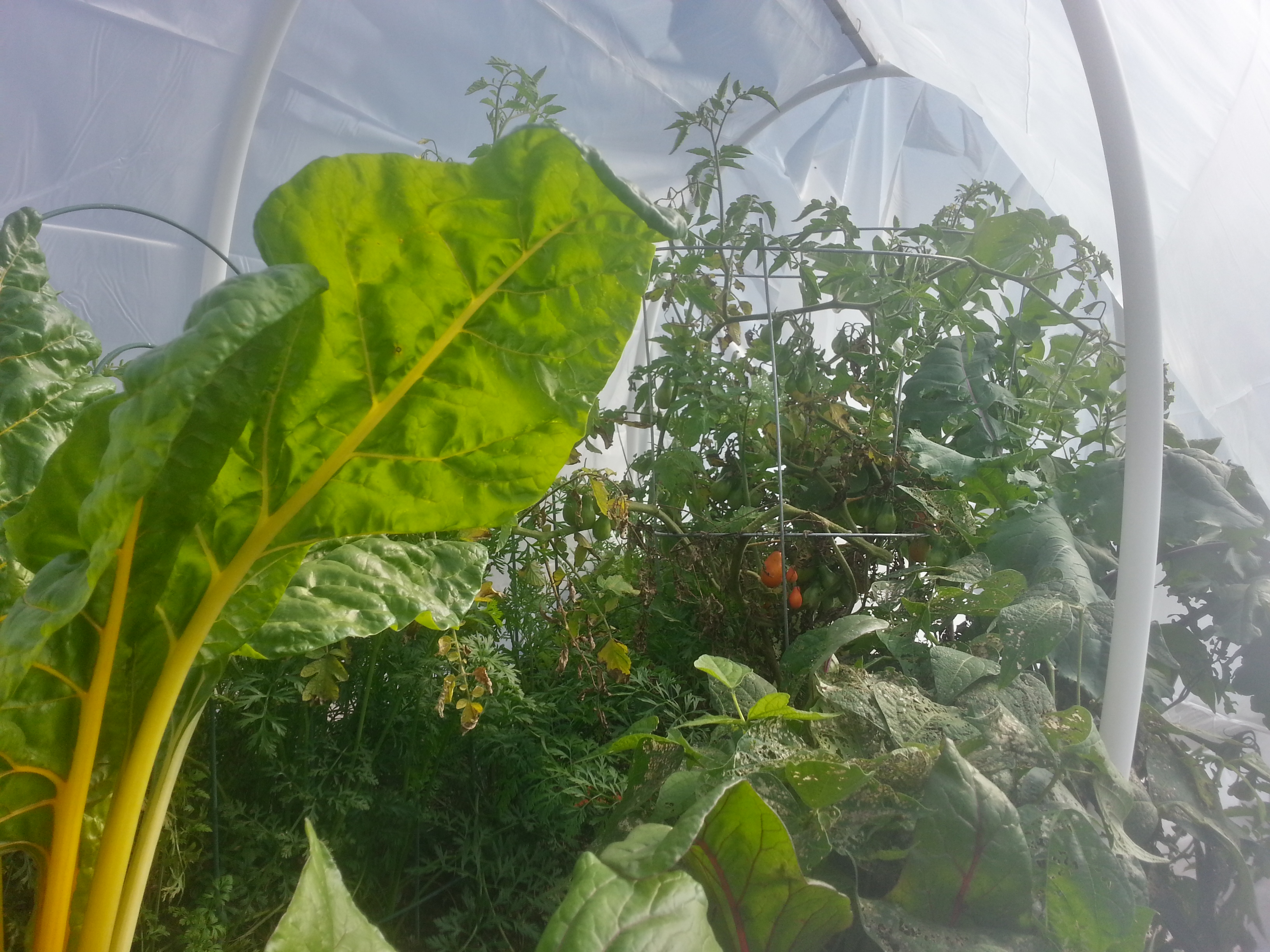
20151004_145325_HDR

From outside, it looks like that scene from Independence Day.

20151004_145222

“Release… me…”

After just a few minutes, it definitely felt warmer inside. It was a windy day, though, so I suspect this came more from the plastic functioning as a windbreak. I’m sure the plants will appreciate that as the wind gets nastier.

20151004_145549_HDR

There was some room on the end where I’d ripped out the cucumbers and melons. I had planned on planting peas there, but since the trellis didn’t make it into the enclosure, it wasn’t in the cards. Rather than planting something new, I decided to fill the space with as many hot weather containers as I could fit.

This is my secret garden – the three-foot-wide strip of concrete along the side of my house. It gets full sun, it’s not in anyone’s way, and while it’s a pain to water, it gives me a steady supply of tiny eggplants.

Plus, the cat loves it.

20151004_150808_HDR

After some agonizing, I picked out my strongest producers and carted them down to the garden. I fit three eggplants, a pepper, and a tomato, which I removed from its cage and stretched lengthwise along the kale. You can see one little arm reaching up in the distance. Quarters are tight, but they live in buckets. They’re used to it.

20151004_155954_HDR

And that’s that! The thing that distinguishes a hoop house from a greenhouse is that it’s labor intensive. Where greenhouses rely on heaters and fans to regulate temperature, hoop houses rely on the sun and wind. The sun is absorbed passively. The wind, however, is left to human intervention. The ends have to be opened up daily to allow for air circulation, otherwise the heat from the sun will get so intense it’ll just cook your vegetables where they stand.
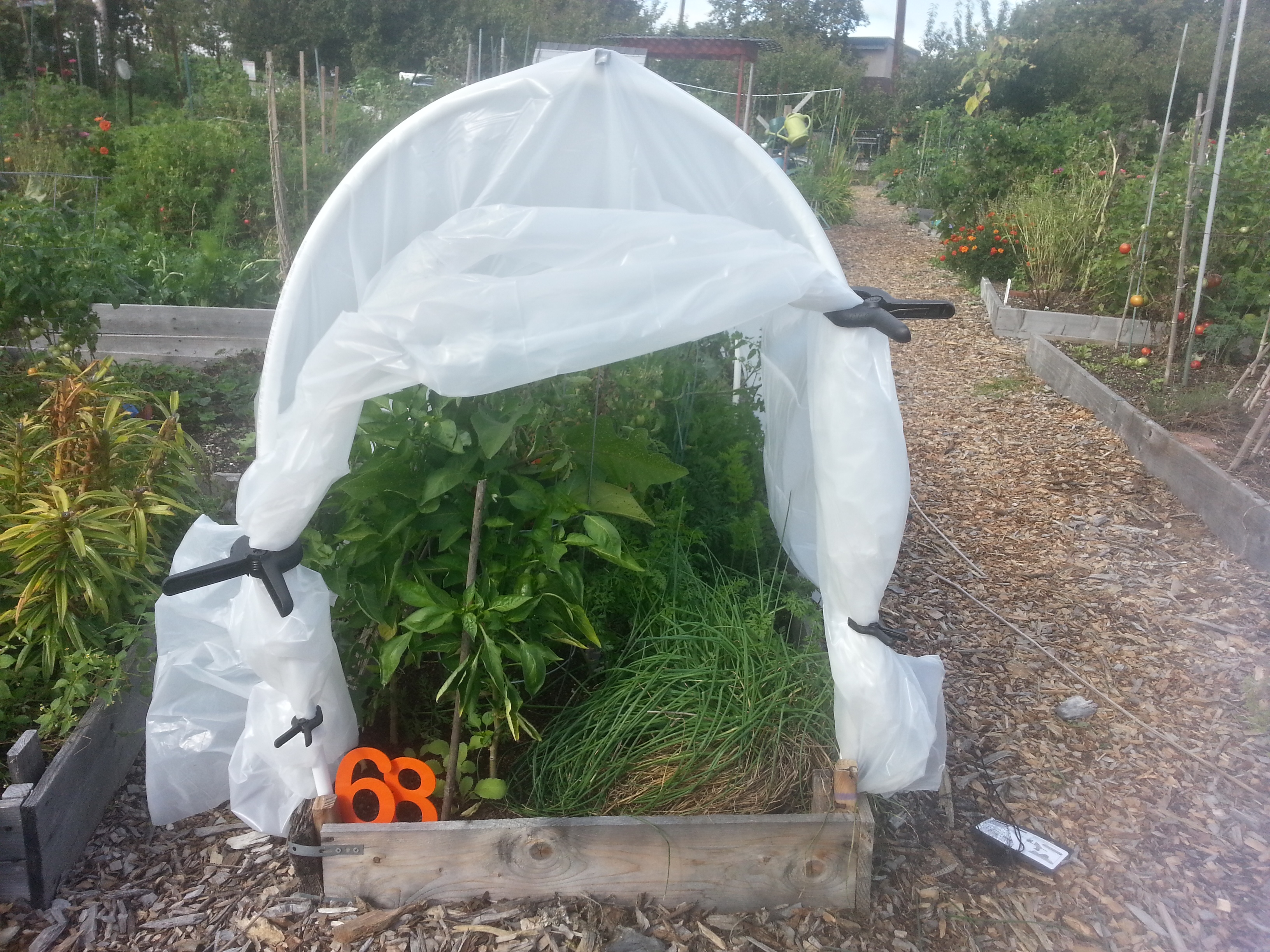
20151004_145721_HDR

Since it’s still warm out, I’m leaving the ends perpetually rolled up, and I’m treating the hoop house mainly as surprise frost protection. Once the temperatures start dipping lower, I’ll have to roll the ends down at night and up in the morning. With any luck, this will keep the warm weather guys alive long past their unprotected neighbors. With even more luck, pollinators will be able to find their way into and out of this thing.

I’m expecting the eggplants, peppers, tomatoes, and squash to give up the ghost eventually. The days are going to get too short and the bees are going to go into hiding, and any tomatoes I eat in January will come from California. For the leaves and roots, however, I have high hopes! With some mulching, and maybe a flap cut into the roof in preparation for access through the many feet of inevitable snow, there’s a chance I could be eating fresh vegetables on Valentine’s Day.

It’s just like they say: Beets are a girl’s best friend.

Bee Update!

I said we weren’t going to mess with the bees.

I lied.

Or rather, once I said we weren’t messing with them, we realized it had been a while since we had messed with them.

So today we messed with them. We went in for a checkup more than anything. We want to monitor their progress and get a sense of if and when we can do another honey harvest.

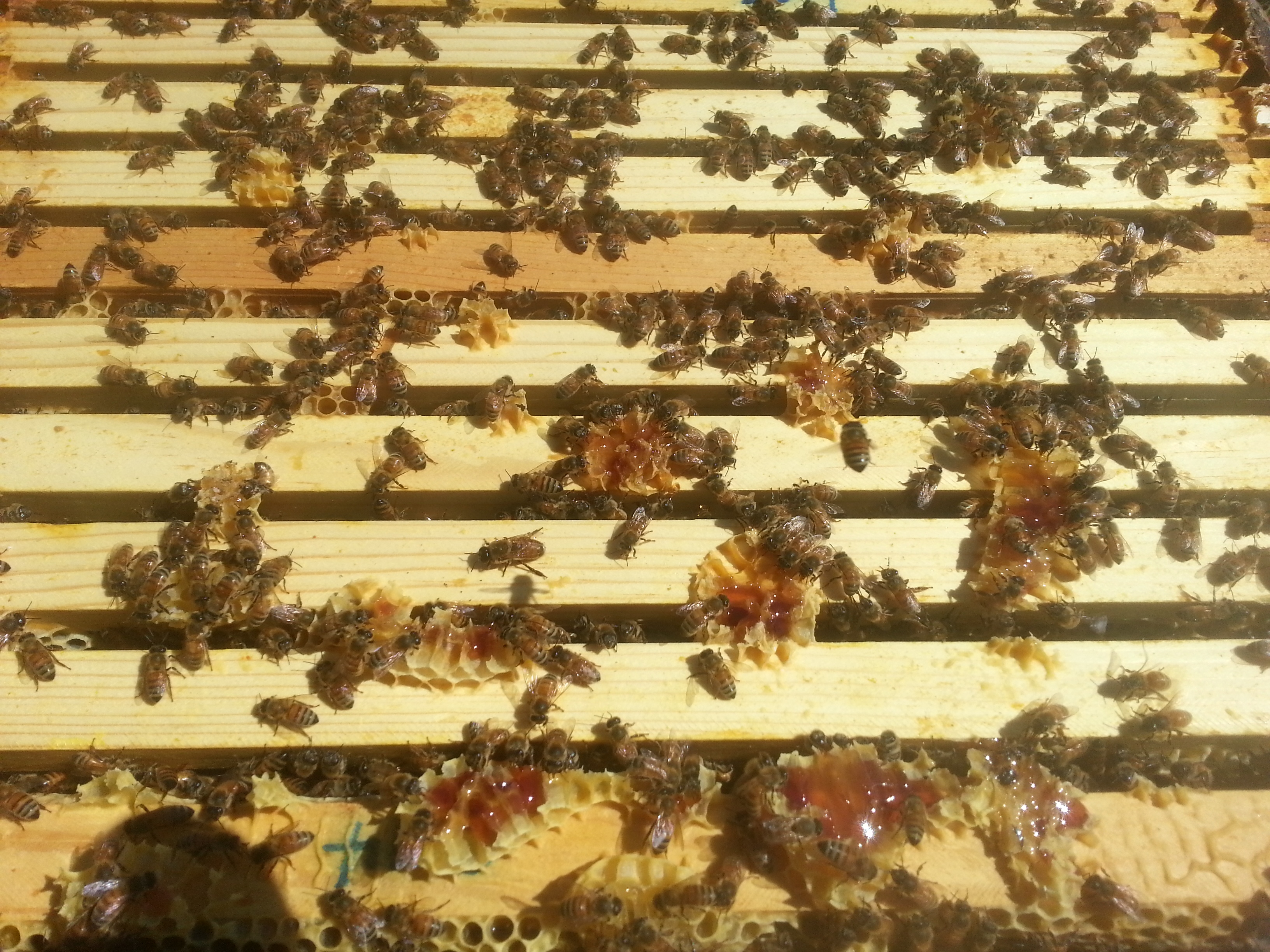
So we opened up the top honey box to see if the hive had made any progress. And I, through thick gloves and sunglasses and face netting, managed to snap this completely centered and focused bee in flight. How did I even do this?20150905_123353_HDRWe weren’t sure if they would have started storing in the new honey box or not. But they have! They’ve built the comb up in every frame and started storing honey in quite a few. These are the frames of the top hive body onto which they’ve built some little honey-filled burr comb extensions. Just like in those 2013 bottles, this late-season honey is noticeably much darker in color that the stuff we’ve already harvested. We tried a little bit, and I swear it tasted like elderflowers. Who knows. 20150905_123519_HDRAfter exploring the honey box, we delved into the top hive body. Production down here is also at full throttle. These bees are exceptional. If I have my own hive someday, I’m gearing myself up for some serious disappointment. The capped cells stretching into the distance are brood – each one contains an egg or larva that will eventually be a worker bee. In the foreground and running along the right edge of the frame are drone brood, identifiable by their bumpiness. The drones are the only males in the colony and kept around only for breeding with neighboring queens. I could say something wry about men here, but I won’t.20150905_123736_HDRInstead I’ll show you this picture of the miracle of birth! Most of the bees in this picture are workers going about their business with their heads in the cells. To the far left of the frame, however, halfway down, are two bees coming out of their cells headfirst. These are drones emerging for the first time from the cells they were laid in as eggs. About four cells northeast of them is another drone a little behind in the process, still breaking through his wax cap. All you can clearly see are his antennae. 20150905_123723_HDRIn a by-and-large positive checkup, there was one ill omen: propolis. The stuff acts as a sealant, and while it’s perfectly natural for it to be here, Kim says the fact that it’s so prevalent and so thick this early in the season means the bees think it’ll be an especially hard winter. This is bad news for me, because I still haven’t gotten over last winter. And it’s bad news for the bees, because they have a heck of a time surviving the cold. Our colony last year didn’t survive. Neither did something like 40% of the colonies in Rhode Island. We love these bees, though, so we’re going to do our best to keep them alive. If we do take another batch of honey, we’re only taking half at the most. And I’ll be cooking up fondant and hopping the fence to feed them when the snow’s too deep to open the garden gate. Hopefully they make it!20150905_123436_HDRBut for now the weather’s still warm and the bees are loving it. In fact, look who I found later in the flowers by my house! She’s not necessarily one of ours, but I’m choosing to believe she is. 20150905_133854_HDR

Honey on Tap

Two bee posts in a row? But how? 20150801_113442

Truth be told, my last post was about events of a few weeks ago. Today’s is about today. So, through blog magic, you get to see the results of nearly a month of honey box action!

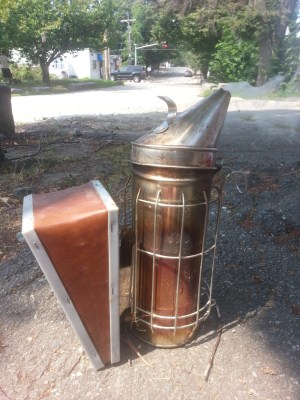
Before going in, we always thoroughly smoke the bees. Using this great little steampunk contraption we slowly burn pine needles, pumping the bellows occasionally to create nice puffs of white smoke. Once you’ve let the needles burn for a few minutes, the smoke changes from hot to just warm and, for bees, intoxicating. It has a real calming effect on them that beekeepers have known about and exploited for centuries. And it really does seem to work. 20150801_112412

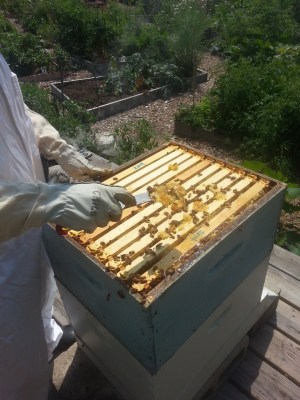
After giving the bees a few minutes to get drowsy, we prised open the hive. We set the honey box aside for a moment and examined the top box in the hive body. This is where the queen ought to be laying and new bees growing up big and strong. These frames were covered in honey that had dripped down from the honey box. A very good sign.

We took a peek inside the top hive body: no sign of the queen this time either, but there was a huge amount of brood (egg cells), as well as larvae and some honey and nectar. Basically all evidence of a healthy and productive colony. 20150801_114135 (1)

After that it was into the honey box.

We could tell just from lifting it that the bees had been at work. Honey ain’t light.

The honey box is working exactly as we were hoping it would. Of the ten frames, two and a half are completely filled with honey and capped, meaning the bees have declared it done and sealed it off for storage. All the rest of the frames have at least some honey in them. This couldn’t be going better.

The bees are working at a very fast rate, which means we have to take our next few steps fairly quickly. For one, we’ll want to add another honey box so they have plenty of room to expand and won’t slow down production or move honey storage back down to the hive body. For two, we’ll begin our honey extraction. We have a special excluder screen that fits under the honey box and allows bees out but not back in, because honey collection is easier when thousands of bees aren’t involved. 20150801_114623 (1)

Or so I’ve heard.

I’ve cross-posted this one with the community garden’s blog, too. Go give it a read!

Fulfilling a Dream

I’m becoming a beekeeper!20150613_125532

Eventually.

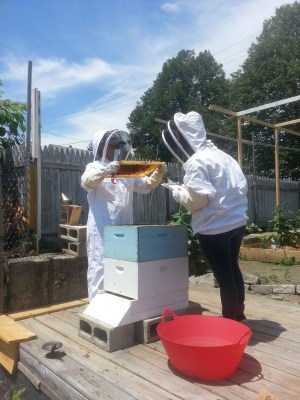
I’m a lot closer than I used to be, anyway. The community garden I belong to keeps its own bee colony, and I’m apprenticing Kimberly, the garden member who actually knows what she’s doing. I’m the faceless one on the right. I promise it’s me.

The New England winter this year was famously awful. You may have heard about it. Or experienced it. A huge number of bee colonies died, and ours was one of them. So we ordered a new starter colony. Out of a little mesh crate about the size of an actual bread box, we released a few thousand bees into our hive. They’ve had a little over a month to get settled, and they’re doing great.

20150505_131550They’ve been filling up their first box nicely, so recently we put a second box, the blue one, on top. Yesterday we went in for the first time since then to see if the queen had moved up to the second box to continue laying. Kimberly prised the frames out one at a time and I noted our findings on my little clipboard.

My Findings:

The bees are loving it in the second box. They’re active in at least half the frames, collecting nectar and storing honey. And the queen, most importantly, is out and about and laying eggs. Queens are pretty easily distinguishable from the rest of the colony, mainly because they’re so much bigger. You can pay a little extra, though,20150613_130035 to get your queen shipped with a splotch of blue paint on her back. It’s easier for us, and it’s easier for blogging. There she is, right in the top middle.

We took a peek into the bottom box, but didn’t open it all up because we’d already been messing with the bees for a while and didn’t want to keep disturbing them. There’s still a whole lot of activity down there, so next time we’ll go in and see what those guys are up to. Once most of the frames have been filled up, we’ll add a third box on top, as well as a queen excluder, which is a fine grating the worker bees can fit through but the queen can’t. That means the third box can be devoted to honey, without a bunch of eggs getting in the way. But that’ll be later in the summer. For now we’re just observing, and I’m taking notes on my clipboard.

-Bees watch out

And expressing myself artistically.