Two bee posts in a row? But how? 
Truth be told, my last post was about events of a few weeks ago. Today’s is about today. So, through blog magic, you get to see the results of nearly a month of honey box action!
Before going in, we always thoroughly smoke the bees. Using this great little steampunk contraption we slowly burn pine needles, pumping the bellows occasionally to create nice puffs of white smoke. Once you’ve let the needles burn for a few minutes, the smoke changes from hot to just warm and, for bees, intoxicating. It has a real calming effect on them that beekeepers have known about and exploited for centuries. And it really does seem to work. 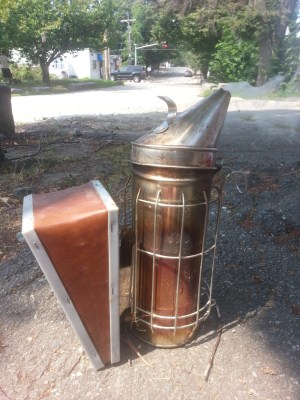
After giving the bees a few minutes to get drowsy, we prised open the hive. We set the honey box aside for a moment and examined the top box in the hive body. This is where the queen ought to be laying and new bees growing up big and strong. These frames were covered in honey that had dripped down from the honey box. A very good sign.
We took a peek inside the top hive body: no sign of the queen this time either, but there was a huge amount of brood (egg cells), as well as larvae and some honey and nectar. Basically all evidence of a healthy and productive colony. 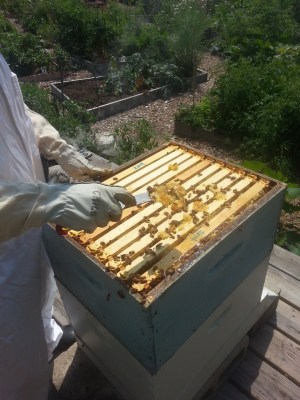
After that it was into the honey box.
We could tell just from lifting it that the bees had been at work. Honey ain’t light.
The honey box is working exactly as we were hoping it would. Of the ten frames, two and a half are completely filled with honey and capped, meaning the bees have declared it done and sealed it off for storage. All the rest of the frames have at least some honey in them. This couldn’t be going better.
The bees are working at a very fast rate, which means we have to take our next few steps fairly quickly. For one, we’ll want to add another honey box so they have plenty of room to expand and won’t slow down production or move honey storage back down to the hive body. For two, we’ll begin our honey extraction. We have a special excluder screen that fits under the honey box and allows bees out but not back in, because honey collection is easier when thousands of bees aren’t involved. 
Or so I’ve heard.
I’ve cross-posted this one with the community garden’s blog, too. Go give it a read!
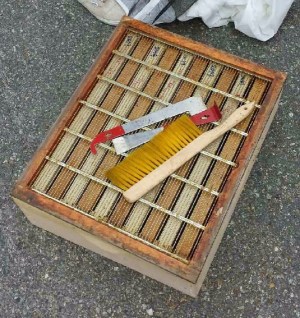
 My friend Tommy,
  I had already tucked my jeans into my socks when we discovered some holes worn through in a particularly bee-vulnerable area. I didn’t want to go all the way home for new pants, and I certainly didn’t want inner thigh stings. We had a roll of masking tape in with the equipment, and when needs must…
 The last few times we’ve been able to find the queen, but this time she was hiding. This isn’t particularly worrying – there are thousands of little guys crawling around in there, and you can’t let yourself get down just because you didn’t find a specific one. It’s mainly good to find her because it shows she’s active, but with all the eggs and larvae present, it’s easy to intuit.
 filled up their hive – the existing queen leaves, taking roughly half the population with her to seek greener pastures. The remaining colony stays behind with a freshly hatched queen. Our plan, if this does happen, is to steal the new queen before the swarm and raise her up separately in her own little queen nook. This way we’ll have an extra queen in our pocket if ours suddenly dies or a neighboring beekeeper loses theirs and calls in a favor.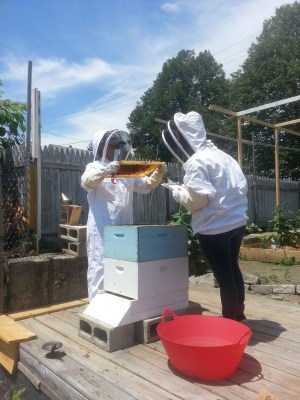
 They’ve been filling up their first box nicely, so recently we put a second box, the blue one, on top. Yesterday we went in for the first time since then to see if the queen had moved up to the second box to continue laying. Kimberly prised the frames out one at a time and I noted our findings on my little clipboard.
 to get your queen shipped with a splotch of blue paint on her back. It’s easier for us, and it’s easier for blogging. There she is, right in the top middle.
 Liz Baessler